Dystopian fiction has long served as a mirror to our fears, reflecting societal anxieties through imagined futures. Among these cautionary tales, Margaret Atwood’s “The Handmaid’s Tale” stands as a narrative that pierces through complacency to confront issues of power, oppression, and resilience. As the series embarked on its sixth season, it continued to resonate with viewers worldwide, its relevance undiminished by the passage of time.

A bit of a refresher
Set in the fictional totalitarian society of Gilead, “The Handmaid’s Tale” unfolds against a backdrop of religious extremism and patriarchal control. Women are stripped of their rights, reduced to defined roles dictated by their fertility: Wives, Marthas, and Handmaids. The latter, fertile women forced into reproductive servitude, embody the brutal reality of Gilead’s regime. Their red robes and white bonnets have become iconic symbols of subjugation, haunting reminders of a world where women are reduced to vessels of procreation.
At the heart of the series is June Osborne, portrayed with intensity by Elisabeth Moss. June’s journey from reluctant Handmaid to revolutionary leader, is a testament to the human spirit and her enduring resistance against oppression. Her quest for justice, fuelled by loss and defiance, propels the narrative forward, challenging viewers to confront uncomfortable truths about power dynamics and societal complicity that may be out of their usual comfort zone.
Now the final series has aired, and long-time fans of the show and characters have shared their feelings online. Some are happy. Some are not so happy. Some are just plain angry at plot lines. Some are downright mad that the series didn’t stick to the narrative of the book. But this is my turn to share my thoughts on the final season of “The Handmaids Tale.” The season that captured audiences and also divided them too.
Season 6 Review
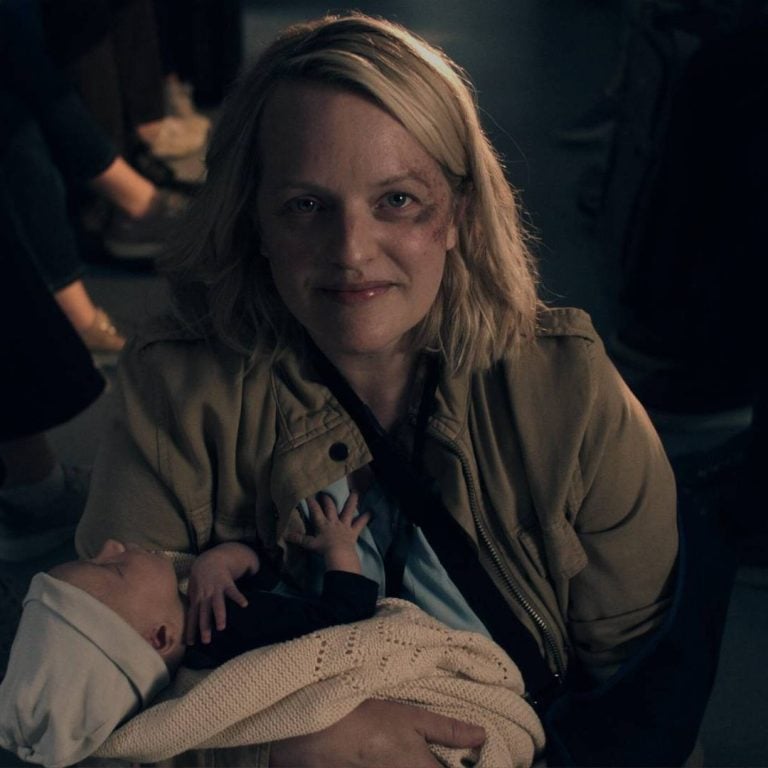
Season 6 was a mixed bag. Let us start at the very beginning. As the series returned, the first episode was entitled, “Train.” Now, remember June hearing the baby cry at the end of season five and telling Nichole that they were going to “see the baby?” Well, they did. The baby being Noah, with his mother Serena.
We started the episode with June and Serena face to face on the refugee train. These two women are fascinating. While their relationship has changed consistently throughout the 6 series, Serena always maintains the upper hand. Serena shows strength and diplomacy (at times) while June shows impulsivity which can lead her astray.
Starting series six with just the two of them ploughing through old thoughts and feelings was perfect. June showed a modicum of respect for Serena for having the guts to finally get out of Gilead. Serena returned the respect in helping her to get her infected arm seen to. June saved Serena and Noah’s life by getting them off the train when the passengers realised who she was. There were a few comedic moments in the episode too as Serena commented that “I’m not going to steal your baby; I’m not some Disney villain” when ironically that is exactly what she was. A villain who stole a baby! Junes baby.
Moving on, the next episodes left us smack bang in the middle of Junes long running story that had now moved away from its dystopian undertones. The ‘dystopian undertones’ keep the ‘Handmaids train’ on its proverbial tracks, so when you remove the common theme, the train has a potential to derail. When you think of “The Handmaids Tale” we desperately want June to get out of Gilead. However, Gilead holds the interest, so once the interest has been removed, something needs to take its place.
The middle episodes, (2, 3 and 4) were focused on Mayday trying to organise a Gilead takedown. Taking the viewers away from Gilead, the place of interest and where it all started, added a level of tedium to the story. Even retreading steps of the story of the dual love interests felt out of sorts. We have been there, done that. Everyone has a ‘Team Luke’ or a ‘Team Nick’ t shirt, right? It was hard to engage with this. Viewers were looking for something new.
Episode 5 seemed to step up a notch. June and Moira headed to Jezebels, their plan being to bring Janine home and to rescue the women working there. Of course, killing the commanders that visit Jezebels was added into that plan too! But the old June and Nick scenario caused an issue.
The next episode saw June’s impulsiveness cause a problem that escalated dramatically. June, who had placed her trust in Nick (yet again! When will she learn!), finally came to learn what we all knew all along. Nick is a Gilead supporter, an eye, a commander, a driver, a soldier and what’s more, he sold her out to save himself. Nick shared her Jezebels plan with his father-in-law Commander Wharton. The result of this is that Jezebels was shut down and the women were executed, all except Janine who was grabbed by Commander Bell and taken back to his house. Seriously writers, Janine needs to have some good luck and a bit of a breather!!
Over the next couple of episodes, we saw Serena courted back into Gilead by Commander Wharton. We also watched Nick settling further into his position as a soldier of Gilead. He may have felt he was in love with June (for the record, I don’t. I think he has used June all along!) but Nick proved once and for all in this season, that he is committed to Gilead.
Serena and Commander Wharton are married in a big Gilead society wedding. Rita was asked to make the cake which she does, all the while lacing it with sleep agent to knock out the Commanders and their wives. The Handmaids are given a knife to do what needs to be done. Aunt Lydia came to the wedding (even after being sent away by Commander Lawrence) and spotted the uneaten cake by the Handmaids seats. She puts 2 and 2 together, chasing down the Handmaids. With Lydia screaming, “where is she?” June Osbourne steps in to frame and says, “I’m here.” After an explanation, Lydia realised that she must let these women be safe. She lets them go.
After the wedding, Serena seemed under the influence (wrongly I might add) that she would be back in Gilead with the ability to make change for all who are there. From the moment she arrived home after the wedding, and saw a handmaid waiting, she realised she had done the wrong thing. She fled her home.
Season 6, episode 9 landed and with a title of “Execution,” let’s just say it did not disappoint. The handmaids carried out their plan, killing as many of the Commanders as they could. June saved her knife for Commander Bell as she went to get Janine. But the handmaids were caught. June, while being held in a prison, shared a verbal exchange with Commander Wharton. Then the titled ‘execution’ is commenced. It is a public execution for the Handmaids, June standing in the centre with the noose around her neck. With the Handmaids awaiting execution, we see Aunt Lydia brought out to join them. When Lydia speaks, she makes it clear that she supports the Handmaids. While being offered a chance to atone for her sins, June uses it as a rallying cry and yells, “Don’t let the bastards grind you down” as she is lifted by a crane, the noose tightening. The rebellion gets underway, and June is rescued.
Following the rescue, June realised that several high-ranking commanders are still alive. Serena, following questioning and encouragement from June, gives up their location and the plans. Commander Lawrence is supplied with a suitcase bomb by Mayday, the intention being that he puts it on the plane and steps away to live another day. Sadly, he could not get off the plane in time and both he and Nick were part of the final explosion. The final shot of the episode is a directorial masterpiece as June stands on the runway, her face illuminated by the exploding plane.
It brings us to episode 10, the finale. Now there were many people watching who were furious that June, Luke and Hannah were not reunited. Have these people not read ‘The Testaments?’ There was internet fury at Nicks death. There was anger at Luke and June not getting back together. But after several years of Gilead trauma, you don’t just walk back into your old life, do you? It was good to see that this relationship was acknowledged that it was now different. Luke himself saying that they will have to ‘start again.’
Episode 10 was a slow one. It wrapped up a few loose ends. As June stood in front of the shop that used to be the ice cream parlour and Alexis Bledel was beside her as Emily, that was a nice moment. The “pious little shit” line was a great added touch.
It was good to see that Serena was not killed off. There is just something about Serena that I always loved. She had a vulnerability but a strength. She had courage but equally she was scared at consequences for that courage. To see Serena end in a refugee camp with a chair, table, window, bed, just as June had at the start, was poetic. For Serena to also end with June’s forgiveness was a special moment. Given everything that Serena had done, for June to forgive that, took some courage.
Even more satisfying for me, was Janine and Charlotte. I have seen a lot of comments where people state that they could never imagine Naomi giving her up, but to those people I say, think back to the start. Naomi was forever frustrated by her child, always shouting at her as a toddler. I can also imagine Aunt Lydia explaining to her about everything that Janine has gone through and how this is the right thing to do.
The final scene as June walked up to the Waterford house in her teal coat (nice touch there!) was perfection. The cinematography was perfect and the direction sublime. To see June start to tell her story….it brought everything round to the start. We saw June telling “The Handmaids Tale.”
Was this as good as other series?
Now, did this season live up to the standards set by earlier ones? Sadly, I don’t think it did. While certain episodes shone brilliantly — particularly 1, 2, 9, and 10 — the series as a whole fell short.
Elisabeth Moss, however, is still extraordinary as June. Few actors can communicate so much without uttering a single word; her face alone tells a thousand stories. Ann Dowd’s portrayal of Aunt Lydia was equally compelling, balancing fierce compassion for “her girls” with sudden volatility, a duality she played to perfection.
Yvonne Strahovski as Serena Waterford (later Wharton) delivered a wide emotional range, including one I had never seen from her before: naivety. In this season, Serena — usually so sharp and calculating — was manipulated by Commander Wharton into returning to Gilead. For once, she did not see the trap coming, and it cost her dearly.
In the end…
In the end, “The Handmaid’s Tale” leaves behind more than just six seasons of television. It leaves an imprint. It has challenged us to look at the fragility of freedom, the dangers of unchecked power, and the resilience of the human spirit when confronted with brutality. While Season 6 may not have reached the consistent heights of earlier years, it still delivered moments of breathtaking tension, quiet poetry, and raw emotion that will stay with viewers long after the credits rolled. The characters — flawed, layered, and achingly human — have lived in our heads and hearts for years, and saying goodbye to them feels a little like closing a book you are not quite ready to finish. But as June reminded us, “Don’t let the bastards grind you down.” The story may have ended, but its warning and its hope — remain.