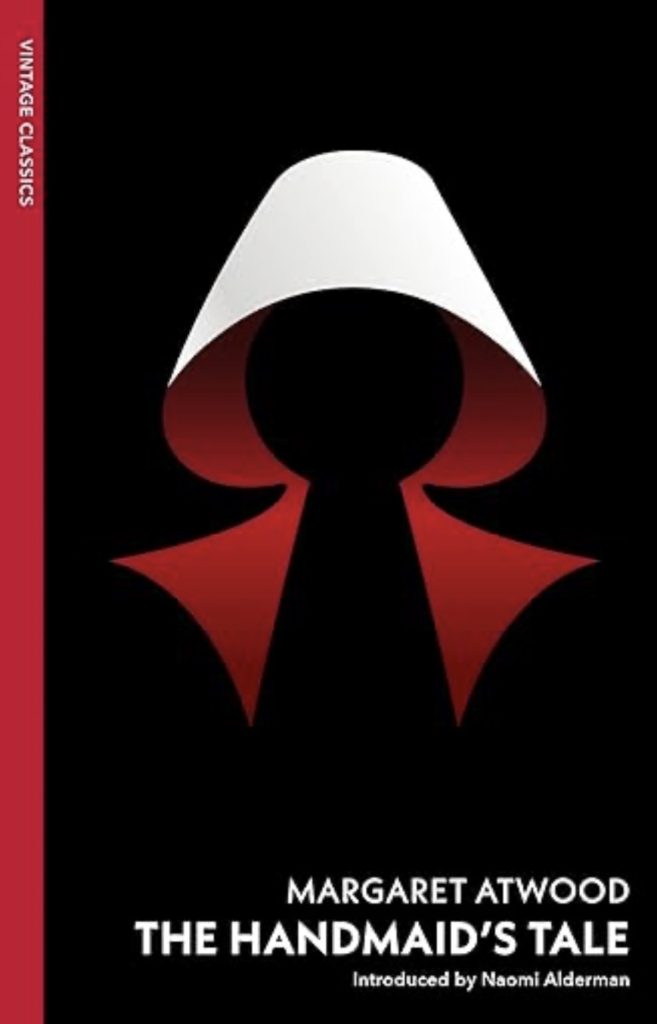
The story is told by Offred/June, a woman whose life has been reduced to a function, an unpaid job. In the Republic of Gilead, women are categorised, controlled, and renamed. Offred’s name, for instance, is not an identity, it is a label. She belongs to someone – Fred.
This is not a loud, dramatic Hollywood dystopian drama. There are no car chases, no heroic speeches, no moment where someone dramatically shouts, “This ends now!” Instead, there is routine, ritual, and at times silence. Silence in the quiet horror of a life where everything has been decided for you. Silence in a place where one of the rebellious things you can do is remember who you used to be.
What struck me most is how plausible it all is. Margaret Atwood does not build Gilead out of fantasy; she builds it out of history, policy, fear, and the human tendency to say, “Well, it’s not happening to me, so…” right up until it is. It is less “this could happen” and more “this has happened before, just with different uniforms.”
Offred herself is not your typical heroine, which I found refreshing. She isn’t leading a revolution or stockpiling weapons under the floorboards. She is surviving, sometimes only just surviving. She is observing. Remembering. Sometimes complying. Sometimes resisting in the smallest, most human ways. People get hurt due to decisions she makes, and this makes her feel real, uncomfortably so. You don’t admire her from a distance; you recognise her. You might even recognise yourself, which is where things can become slightly awkward.
Because here’s the unsettling truth: most of us like to imagine we would be brave, defiant, or even unbreakable. But Atwood quietly suggests that survival often looks like compromise. Like choosing your battles so carefully, that sometimes you don’t choose them at all.
The writing itself is deceptively simple, clean, and controlled, almost restrained. And that simplicity in the writing is what gives it power. There are moments of beauty, even humour, but they sit alongside an ever-present tension, paranoia, and fear.
And then there’s the matter of relevance. If this novel felt timely when it was first published, it now feels almost prophetic. Reading it today is a bit like reading tomorrow’s newspaper, only with better prose and significantly more dread.
It raises questions you cannot easily answer:
- When does normal become unacceptable?
- Would we notice the change while it was happening?
- How fragile are the rights of a person if a religious group like the ‘Sons of Jacob’ can remove them so quickly and easily?
By the time I reached the end (on one of my many re-reads,) there was no neat bow, no comforting resolution. No happy ending. No reunited family. What there was at the end was more questions than answers?
And that is precisely the point. The Handmaid’s Tale does not exist to comfort or resolve; it lingers, unsettles, and quietly refuses to let you look away. It closes not with certainty, but with a disquiet that follows you long after the final page. It reminds you that complacency is often the first step toward complicity, and that the line between “then” and “now” is far thinner than we would like to believe. It is not just a story you read, but one you carry—uneasily, persistently—with you.