Romancing Fantasy and Reality: Why “Romancing the Stone” Still Charms Decades Later
Think about the movies. Think about all the ones you have seen in your lifetime. Some of them stand the test of time. Think “Saving Private Ryan” or “A Few Good Men.” Yet some fade quietly into the background of cinematic history. Then you have some that are just what I would call ‘feel good’ movies.
Now roll the clock back to 1984. Robert Zemekis has released a movie called “Romancing the Stone.” This movie sits centrally in the category of ‘movies that have a sparkle no matter when they were made.’
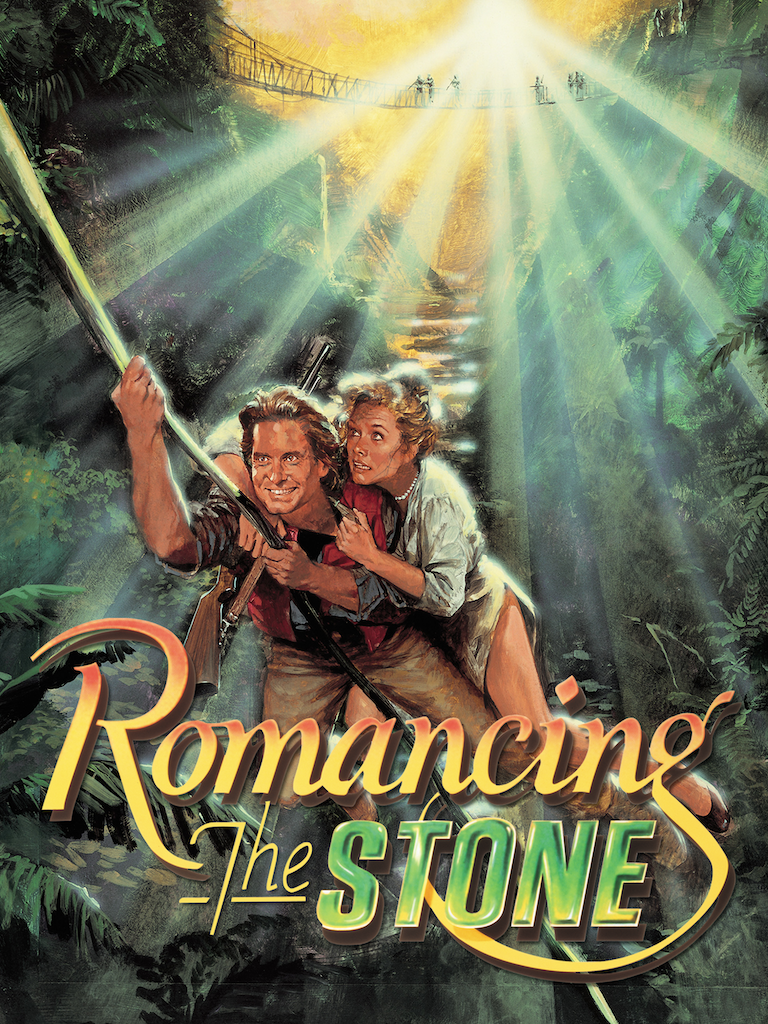
RTS is a film that is what I call, an easy watch. It understands its audience and its genre. Most importantly, it understands itself, it does not try to be anything it isn’t. It is a simple film that blends romance, adventure, and comedy with the two remarkable leads (oh, and Danny DeVito)
The story is centred around Joan Wilder. Thank you Kathleen Turner for the nuance that you bring to the role. Joan is a successful novelist who tips the scales at life. On one side, tales of passion and peril are crafted on her pages. On the other, Joan’s life is normal, ordinary. She is cautious and introverted, far more comfortable with her fictional counterparts than human equivalents.
When her sister is kidnapped, Joan ends up being a central character in the very plots she writes. She must step out of her comfort zone and enter the jungles of Colombia. The world is unscripted and Joan has to navigate that. Quite often, with hilarious results.
While her journey to find her discovery offers self discovery as well as survival, Joan’s human evolution is the films core and strength. She falls, stumbles, hesitates, and learns. Courage is earned not imposed on her. She is a representation of her audience. Uncertain, overwhelmed but capable of far much than she gives herself credit for.
Now, enter the leading man, Jack Colton, ably portrayed by Michael Douglas. His charm, a little rugged in nature, and his opportunism are the counterbalance to the naivety of Joan. Jack is not a stereotypical hero. He is self-serving, slightly disreputable, and often motivated by profit rather than principle. But these qualities make him compelling. As the story progresses, his rough edges soften, revealing a character who is just as capable of growth as Joan.
The chemistry between Turner and Douglas is undeniable and something extra special. The chemistry elevating what could have been a conventional romance into something far more engaging. Their verbal exchanges are sharp, witty, and often with a playful tension that keeps the audience invested. The ‘will they/wont they’ tension is paramount throughout.
Another layer that is important to the film is the presence of Danny DeVito, whose performance injects a delightful unpredictability into the narrative. His character, driven by greed and desperation, serves as both antagonist and comic relief. DeVito’s timing is impeccable, and his ability to switch between menace and absurdity ensures that the film never drifts too far into seriousness.
What makes Romancing the Stone particularly enduring is its ability to balance several different genres. It is a romantic story, an action-packed adventure, and a self-aware comedy, all at the same time. It draws its inspiration from the adventures through the 80s such as the Indiana Jones films. But where an Indy film leans into action, RTS takes itself to a different level. It focuses on the characters and has a willingness to make fun at its own themes. For example, cliches of romance and adventure are acknowledged throughout, but delivered with a healthy dose of sincerity.
At the core of the film lies a thoughtful exploration of the relationship between fantasy and reality. Joan begins the film as someone who creates idealised worlds in her novels and appears more comfortable in those. Yet she has little experience navigating her own world, finding it overwhelming. But as she moves through the jungle—both literally and metaphorically—she begins to understand that real life does not conform to neat narrative arcs that she usually puts on paper. It is unpredictable, often inconvenient, and occasionally terrifying. Yet the real world is also richer and more rewarding than anything she could have imagined.
Robert Zemeckis’s direction plays a crucial role in keeping this delicate balance. His approach is confident and energetic, ensuring that the pacing never falters. Each scene flows seamlessly into the next, creating a sense of momentum that enables the watcher to plunge into the adventure alongside Joan. The lush South American setting further enhances the film’s appeal, providing a vivid backdrop that feels both exotic and immersive. The environment is not merely decorative; it is integral to the story, shaping the characters’ experiences and amplifying the sense of danger.
Ultimately, Romancing the Stone succeeds because it never loses sight of its purpose: the purpose is to entertain. It does not try for any complex storyline’s or to be something it isn’t. It focuses on delivering a cohesive, engaging experience that resonates on multiple levels. It is a film that invites audiences to laugh, to feel, and to momentarily escape into a world where ordinary people can rise to extraordinary challenges.
Decades after its release, its charm stays intact. The performances are as engaging as ever, the dialogue still sparkles, and the story continues to captivate. In revisiting it, we are reminded of a time when films were unafraid to be both earnest and playful, when adventure and romance could coexist without cynicism.
In the end, Romancing the Stone is more than just a film; it is a celebration of storytelling itself. It takes the familiar elements of romance and adventure and breathes new life into them, creating a narrative that feels both timeless and refreshingly self-aware. For anyone seeking a film that combines heart, humour, and a sense of adventure, it is still, quite fittingly, a treasure worth rediscovering.