AUGUST
Housework Isn’t Invisible – We Just Tell Ourselves It Is
The saga of the invisible housework. You know those chores around the house that magically get done? Clean towels reappear. Beds are changed. Bins are emptied and clothes you threw into the washing basket that very morning, reappear hung in your wardrobe as if they had never left. No one ever sees when these tiny things happen, but they do. But is housework invisible? Or are we collectively choosing to ‘selectively ignore’ it.
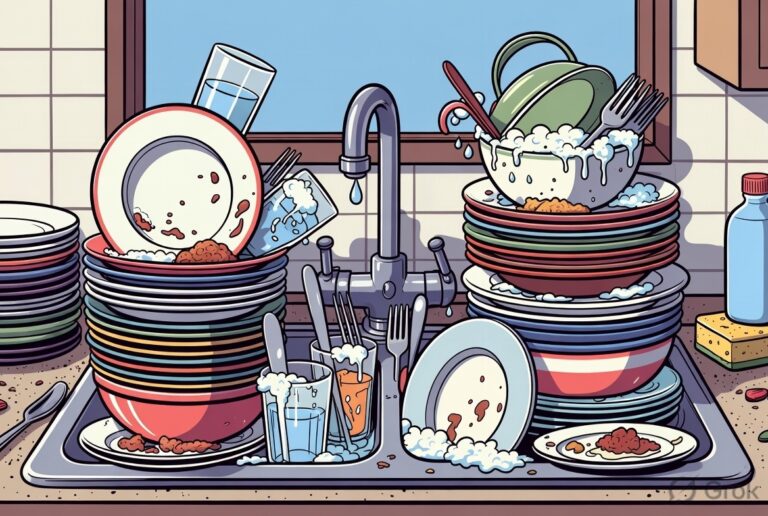
Housework is the noise of every day life. When you live beside a railway line, you do not notice the noise until the trains stop running and it is quiet. Housework is the same. While it is the noise of everyday life, we only hear it when it stops.
You do not notice a dishwasher being unloaded before you get up but if there are no cups for that morning coffee, then the housework noise grows louder. You don’t see a bed being stripped but you recognise the smell and feel of clean sheets. The work seems “invisible” because of its normalcy.
A clean house does not announce itself with a parade. No one walks into the room and announces the seventy-two individual tasks that led to this moment. Everyone simply sits on the couch, puts their feet up, and assumes the universe has been kind. We have become experts at noticing the absence of housework rather than the presence of it. It is a bit like oxygen and breathing. You don’t think about it when it’s there, but it is instantly noticeable when it’s not.
When you think about it though, housework is a series of small tasks, thankless ones. Housework is a mission that never ends. No finish lines. No medal ceremony. No standing ovation. No national anthem played in honour of the bathroom being cleaned for the 10,000th time. Instead, there is simply… tomorrow.
Tomorrow that mission continues. Crumbs come back to find you. The washing basket refills as if by magic, domestic magic of course. These things are not dramatic; they are just there. There is no great documentary titled, “The Great Dishwashing Debarcle.” Just small repetitive actions that hold life to its path.
Housework is infrastructure. It is the behind-the-scenes system that allows everything else to function. Meals happen because someone shopped. Clean clothes exist because someone sorted, washed, dried, and folded them. Guests feel comfortable because someone quietly made the space welcoming beforehand.
If housework stopped entirely—even for a week—the illusion of “invisible” would vanish very quickly. You would see it in the bins that would need emptying, the floors needing mopping, the fridge needing filling, and the growing pile of “I will deal with that later.” We only fail to see housework because it is often done pre-emptively. It is anticipation disguised as routine. Someone notices the milk is low before it runs out. Someone wipes the bench before it becomes a science experiment. Someone replaces the toilet paper roll before a household emergency occurs.
There is also a long-standing cultural habit in life, particularly in family homes—of assigning housework the lowest value because it is unpaid and domestic. If you spent three hours cleaning an office space, that would be called productivity. When you spend three hours cleaning your own home, and it is called “just housework.” The use of that language alone shrinks the effort.
“Just” doing the washing. “Just” vacuuming. “Just” tidying up. It is almost as if the effort to do them is something not worth talking about. If you are cleaning a kitchen, I mean really cleaning a kitchen, then “just housework” becomes manual labour. “Just housework” becomes some serious heavy lifting.
Housework is not just physical; it is mental as well. There is planning involved. Timing. Organisation. Decision-making. You have to remember what needs doing before the urgency kicks in. It’s a mental, low-level awareness of the household system. The mental load of housework is the most invisible. You cannot see someone remembering that the last clean towel has just been used. You only see the fresh ones appear.
Isn’t this the greatest irony of it all? A well-run home looks effortless from the outside. What is interesting is that the more efficiently the housework is done in that well run home, the more invisible it becomes. We do it so well, that it’s not seen. We enjoy every comfort of it without recognising the hours it took to maintain it.
It’s not malicious. We are not being unkind. It is just habit. We grow used to the rhythm of daily life and stop noticing what keeps that rhythm going. But maybe the goal isn’t to make housework more glamorous—it is simply to make it more visible in our awareness.
To notice when the bins have been emptied. To acknowledge the person who cleaned the bathroom before guests arrived. To recognise that folded washing does not happen by accident. Because visibility doesn’t require applause or grand gestures. Sometimes it is just a simple, “I see that.”
But it is one of the most consistent, necessary, and quietly significant forms of work we do. It is not invisible. It has never been invisible. We have just been exceptionally good at looking past it—right up until the day it doesn’t get done.
JULY
Memories Are a Story We Keep Rewriting
Imagine this. You’re folding the laundry, making tea, or driving somewhere familiar. Then it hits you. A memory is there. Just as if it has been waiting for its cue to step forward from stage left. There it is. The memory is formed and ready to revisit with you for a version of the past. You think to yourself, “I remember it so well.” But you know what, it probably didn’t happen the way you are thinking.
Memory is not the historian we think it is, at least not a faithful one anyway. It is not a recording device that guarantees security of our lifetime’s memories. Memory is a storyteller. Every so often, it rewrites the story.
Think about it this way. You would like to retrieve a memory from a night out with friends. It’s not as if the memories are stored in a filing cabinet in pristine condition. You don’t just pick a file and open it. We must reconstruct it, rewrite it. It is a bit like an old favourite recipe. Start with place, add in emotion, perspective, meaning, people and stir in anything sensory. There is your memory. Rewritten in the current day.
The rewriting is where stories are liable to change. If you asked me and my brother to remember the same event, there is a strong chance that there would be startling differences. Ask my brother and me to remember the “super swamp” incident and it would be identical. You have to have been there.
Memory doesn’t document the event, it interprets it. I can remember being at play school with my mum and playing with the kids. I remember it through the feeling not through an age, date, or time. Memories do that. They filter them. What matters to us at ten years old, won’t matter at fifty. What may have been a huge issue may later seem a trivial one. Something that used to feel ordinary, may not weigh heavily.
Time is generous with meaning to memories, but it isn’t always kind with accuracy.
Grief accelerates this. Loss changes the way memories behave. An insignificant memory from five years ago, now has the utmost importance. Memories of my late husband are the example here. His voice, and the way he said my name. The tiniest memory of him falling asleep with his hand on my back. Insignificant at the time but now means so much more. Messing around pretending to drop his cake trying to make him laugh. All memories, memories that become selective and preserve the smallest of details with exquisite care. The event doesn’t change; we do.
With the invent of social media, we have an immediacy of capturing memories. We curate what memories we desire in real time. Best angles, filters, captions, the experience is packaged almost before we have consumed it. The memory is edited prior to it even becoming a solid memory for us. The problem with this, we see and remember a curated version, not the truth.
But isn’t there something profound that lies in the revision of memory? Something profoundly human. We revisit the ‘early us’ but without judgement. Where I felt awkward in my teens, I now know I was doing the best I could. Where school could stress me at times, I know now, that they were the best years ever. The loss of Mark and mum, the most difficult 17 months I think I have ever faced, will always have sadness attached to it, but I can look on that as survival and finding confidence in myself that I didn’t know I had. Memory allows us kindness – most of all, to ourselves.
We’re not static in life as humans. Memories aren’t either. Every time we recall a situation, we bring new understanding and nuance to it, maybe even noticing what we might have missed on the original event. This doesn’t mean that memory is unreliable, it means it’s a living memory, one that evolves.
Emotional truth matters in our memories. It shapes how we see ourselves and how we relate to everyone. It gives value to how we move through the world. Memories are the stories we tell of who we are, what we’ve done and where we’ve been. They are the way we understand what we are capable of. We author our own lives; we edit it a bit too.
The challenge for every human is not to freeze frame a memory, however appealing that may seem. It is to realise that memories constantly evolve. We should always approach memories with curiosity. I often ask my dad, “am I remembering this right?” Many times, I am not.
Memories are living documents, not carved in stone, or locked away in a vault. Every time a memory comes back, we pick up that metaphorical pen and make another mark on the page.
The past stays in the past, it always will. But the stories will continue to change. That is not a flaw in our memory, it’s kindness
JUNE
We need to stop treating friendships as optional extras.
Somewhere along the way, maybe it was the invent of social media, or maybe it was the trajectory of life itself, but friendship was downgraded. It didn’t end. It wasn’t dismissed. It was shoved off the main stage. Now it sits quietly to one side while we all do the obligatory social media “likes” for careers, marriages, kids, productivity and having it all together. It seems we, the human race, decided to have optional friends. Friends that are nice to have but ones that can fit in around the edges of real life. To be honest, that is a load of twaddle.
Friendships seem to be more like a hobby nowadays. One that we step into when we have time and abandon when we do not. One that we don’t hesitate to say yes to when we want our night out, but one that we’ll “take a raincheck” for in a heartbeat. We don’t seem serious about them. We protect the romance in life, but we don’t protect the friendships. We don’t schedule friendships with any seriousness. My question would be, ‘do we even grieve a friendship when it ends?’ Or do we just assume that life got in the way and carry on.
While we know that work is an unavoidable byproduct of life, romantic love is essential in life, and family is nonnegotiable, we follow a script for friendship. To be honest, we don’t even question that script and we should. We assume that friendship is flexible. It understands. Friendship doesn’t mind if you disappear for six months, cancel three times in a row, or only resurface when you’re in crisis. Friendship is the archetype of low maintenance and patience. At least that’s what we expect it to be.
Lives are primarily organised around partners and family, nothing wrong with that. But what about those friendships? Are they standing to the side of the room, holding a name tag that says, “I’m still here” until you have time for them? When you have a partner, they become your person. Your best friends now been stepped down a rung to “best supporting actor.” We don’t verbalise this, but our body language says it loud and clear.
Friendships are usually the thing that is sacrificed first. When life gets busy, it’s the coffee catchups that go, not the work deadlines. When someone moves away, we promise to stay in touch, knowing full well that it’s highly likely we won’t. When friendships drift apart, we shrug and say, “That’s just what happens as you get older” or “we grew apart.”
I often wonder, should adulthood have a warning label that says, Connection may be withdrawn at any time?
Friendships are not something fluffy or just nice to have. They are survival. They are practical, answer giving, shoulder to cry on, call at 3am, ride or die, friends. Friends are witnesses. They knew you before the plot twists of marriage and kids. Friends know your old stories and versions of you from your life. In my case, nursing friends know my early 20s and when I met my husband. My aunty Sally knew everything about me. My Australian first friend knows the version of me that’s gone through work changes, sickness, cancer, losing mum, losing a husband, complete life changes, and moving. She’s the friend that has my husband’s day of death on her calendar (even now after 7 years) and sends me a message. And she’s still here, top of my friendship heap, over 20 years later.
Friends are also the people who see you without needing you to perform. You don’t have to be impressive, productive, or aspirational. Friendships often carry us through the quiet, unphotographable moments of life. The moments that don’t make it onto social media. The moments where nothing is “wrong” exactly, but everything feels heavy. The moments where you don’t need advice, just someone who understands your silences.
And yet, despite all this, we still treat friendships as expendable. We shouldn’t. Part of the problem is that friendships don’t come with a clear script. There’s no ceremony to mark their importance. No vows. No legal recognition. No social milestones. I’ve had people treat my friendship as expendable. Sadly, tht cost mostly with becoming a widow. I changed to a different person; there’s no way I’d ever be the same person again. Friends walked away from me. I was the expendable one.
We don’t talk enough about how much courage it takes to maintain friendships as adults. So instead, we let friendships fade quietly. No dramatic endings. Just unanswered messages and postponed plans until one day it feels awkward to try again. Then we decide that we “drifted apart.”
The irony is that in times of crisis—grief, illness, divorce, loss—it’s sometimes friends who step in when everything else falls apart. Friends who show up with meals, sit with you in waiting rooms, answer late-night calls, and remind you that you still exist outside the worst thing that’s happened to you. Yet once the crisis passes, they go back to their normal life and so do we.
Friendship deserves better than that. It deserves intention. It deserves time carved out not because it’s convenient, but because it matters. It deserves the same honesty we offer romantic partners, the same loyalty we expect from family, and the same respect we give to work commitments.
This doesn’t mean grand gestures or constant contact. It means showing up consistently. It means not always waiting for the other person to make the effort. It means understanding that friendships change, but change doesn’t have to mean loss. Most of all, it means stopping the narrative that friendship is optional. Because it isn’t.
Friendship is one of the few relationships we choose freely—and perhaps that’s exactly why we should treat it with more care, not less. We don’t need fewer friends as we get older. We need deeper ones. We need to stop apologising for prioritising them. We need to stop pretending we’re fine doing life alone. Friendship is not the background music of life.
It’s part of the melody.
MAY
Airports: Where common sense goes to die.
Airports. Romantic notions of stepping aboard a plane to a faraway place. Well, I hate to disillusion you but no. That is not what an airport is. While it is a place that exists to move people in an efficient manner from A to B, an airport is a place where a human loses their ability to think logically and at times their dignity. An airport is confusion of the simplest form and the erosion of common sense.
Think about it carefully. You step inside an airport, and the world suddenly revolves around rules and queues! Shoes are dangerous – take them off for someone to scan them. Water is suspicious – I’ve never quite worked out why. Belts are mandatory to remove for security. You can only take a certain size shampoo bottle through security but airside, it’s safe to get a big one! Go figure! Common sense doesn’t disappear at airports – it is confiscated by the jobsworths at security.
Security is the heart of the airport absurdity. It’s more ritualistic than it is protective. Lap top out of the bag. Laptop in the bag. Chargers out. Chargers back in. Liquids in a clear bag. The bottles too big. Shoes on. Shoes off. Scan this. Scan that. It makes you feel like a criminal. The lack of consistency is shocking.
Don’t get me started on queues. If you’re English like me, you will already know how good the British are at queuing. Airports love a good queue. They are created to go round and round and to disappear back the way you came from. It’s like a theme park queue with no ride at the end (well apart from the plane I suppose) We queue to check in. Queue to drop bags. Queue for security. See where I’m going here can’t you. Queue to show your passport. A queue to get on the plane. A queue on the plane to get to your seat. Every one of the queues has a sign and a sign that contradicts the previous sign.
You get through security. Now there is another issue. Retail therapy. For most people, a dose of retail therapy is welcome but not in an airport. The toiletries that you could not bring from home are now four times the price airside. Everyone is getting in your path prompting you to try perfume, alcohol, and handbags as if that was your normal day. Hunger pangs strike and you know that you should get something, just incase the plane food is something you don’t like. So, you get a sandwich. $20 for a sandwich that tastes like two pieces of cardboard and rubber cheese.
Airports offer up human behaviour for the full psychiatric analysis. There is the military traveller whose been there for three hours prior to checking in time. There is the one that arrives as the gates close and complains that the plane is taxi-ing up the runway without him. There are the travellers that are on their feet as soon as the plane lands because of course, that will get them to the gate faster, and of course these same people will be blocking the aisle as they either don’t know or just don’t care about the other humans that have been on the pressurised tube with them.
Boarding is fun. When the airline calls for families with children, people needing assistance, and priority passengers, why does everyone hear, “Now boarding: all of you, immediately.” You reach your seat, emotionally and physically exhausted. Your device is in flight mode already. Your bags in the locker. Everything you may possibly need is crammed into the seat pocket in front of you. You hope and pray that the seat beside you stays empty but if someone has to fill it, you hope that the phrase ‘personal space’ means something to them.
Airports should be progress. They should be marvels of connectivity and travel. But they feel like a stress test that we have to comply with in order to get anywhere. We accept the absurd as a small price to pay. Perhaps that’s the real reason common sense goes to die at airports. Not because it isn’t welcome, but because it has no power there. Airports run on their own logic, a parallel universe where rules shift, prices inflate, and time loses meaning. We survive by surrendering to it, knowing that eventually—after delays, announcements, and one last unnecessary queue—we will escape.
Until, of course, we must do it all again on the way home.
APRIL
How hobbies helped me stitch my life back together after grief
Grief does not have a timetable. It doesn’t have a manual. It doesn’t shout out, “hey I’m here,” and wait for your response. What it does do is hit you like a sledgehammer. It takes over your life, like drowning in waves. It ambushes you in a supermarket when a product triggers a memory. I lost my husband and my mum in a short space of time. I lost some of the scaffolding of my life. I lost people that propped me up and provided me with rhythm and certainty.
In the early days of loss, the usual platitudes were shared. “Call me if you need me.” Not a helpful one, but it’s one of those things said when people don’t know what to say. Another was “be kind to yourself.” A well-meaning phrase but a useless one when two of the most important people in life had gone. I had enough trouble managing to survive through the day!
What I did not realise was that my hobbies, small incidental things that once were an indulgence, would be the things that stitched my life together. My dad put together and paid for the first year of a website. Madhatterpress was born and I had somewhere to showcase my writing. I couldn’t stop writing. The confusion, grief and anger swirling in my head filtered to the computer screen.
My writing continued. Some pieces started and not finished, just fragmented words and ideas. Other pieces ended up as essays, stories, poems, or blogs. Writing was not a craft, a talent or any of those things. It was my lifeline. It kept me going. It made me laugh. It made me smile as I shared memories on paper. It made me cry sometimes as the grief fell to the page. But an important lesson was learnt. Hobbies don’t fix grief, nothing does – but they help.
There is a pressure placed on the grieving to “move on.” The indication being that grief is a phase as opposed to a reshaping of a person. What’s not well understood is that the reshaping is permanent. Why? Because grief from spousal loss steals not only what you had, it steals your future too. Hobbies resist that narrative. Hobbies don’t rush you or judge you. Even if you disappear for a while, they will wait for you without question.
Besides my writing, but perhaps as a companion to it, one other hobby has been reading. I read differently after loss. I looked for books outside of my comfort zone. It was almost as I wanted to be harder on myself, challenge myself. But I read, and underlined meaningful passages. I read slower, re-reading if I had to.
When you experience loss, and a heavy loss like a partner and parent, you need a way to restore agency to life. Loss has robbed you of choice. You did not choose this life. But when you sit down to read or write, the element of choice returns. You decide what, when, where and how. Having that choice was so important. There were days when all I had were a book and a sofa. Socialising was not optional and silence with a book allowed me to get through a day, sitting in my PJs, without being concerned about being attached to the world or the internet.
Hobbies, while great as a kid, are often trivialised as adults. They are compartmentalised as something we “try to do” after we meet the responsibilities of life. After loss, hobbies are essential. They are your life. They help rebuild your life and remind you of your identity. Your hobbies remind you that your identity is more than what has happened to you.
Before grief, I was a different person. That version of me is long gone. If I pretended otherwise, it would be dishonest of me. Yes, I am a widow. Yes, I am a motherless daughter. But I am also curious, funny, creative, stubborn at times and more. If you are grieving, and someone says, “find yourself a hobby,” it is not an insult. It’s not them trying to distract you. It is about a good friend suggesting a promising idea that may just help you to survive.
Grief does not ask for resilience, optimism, or closure. It asks for something far more practical: a way to keep going. For me, hobbies provided that way. Not as therapy, not as distraction, but as structure when life lost its shape. We do the grieving a disservice when we dismiss hobbies as trivial or optional. After loss, they are neither. They are anchors. They return choice, identity and agency to people whose lives have been ruptured. Mine did not fix my grief—but they gave me a reason to stay. And sometimes, staying is the bravest thing of all.
MARCH
Stop romanticising the perfect family – it doesn’t exist.
The idea of a perfect family is an enduring myth of modern society – especially since the advent of social media. The “family” smiles at us with perfect white teeth from a billboard. It shows the sanctity of life through TV sitcoms. It beams out from carefully curated social media feeds. It lurks behind well-meaning questions such as, “Don’t you want to settle down?” or “Don’t you want to have children?” The perfect family is sold to us as a product that everyone should have. Nice house, nice car, mum, dad, 2.4 children and an unbreakable bond that can survive everything. But seriously? Is that realistic? I am here to tell you that it is quietly and potentially harmful. Why? Because perfection doesn’t exist and when we pretend it does, it can have real consequences.
Generationally, the family is consistently framed as a ‘safe’ place, a place of love and belonging. When it works well, it’s all those things and more. However, romanticising it only serves to ignore a complicated truth. Families are made of people and people are flawed and contradictory. To suggest that families are sacred, wholesome, and whatever element of perfectionism you seek, just serves to deny the lived realities of millions who grew up with the complete opposite. Those who lived realities were neglect, violence, emotional manipulation, and unhappiness.
The perfect family – Is there one? If you examined this question through the arc of social media, you’d say yes. Images of co-ordinated outfits, bright white teeth, beautiful blonde children, affectionate partners sit alongside perfect captions or gratitude. What we don’t see are the emotional and physical labour of a new mother, financial stress, loneliness in grief or mental health struggles. They are pushed aside for the image of perfection as people try to match what they believe to be true. Mess, imperfect lives are measured against edited social media. Newsflash everyone – perfection doesn’t exist.
So, why do we think it does? One word can answer that question. Consumerism the perfect home, family, holiday, clothes, all require spending and that’s where our ideal family becomes a marketing tool. It reinforces (wrongly) that perfection and happiness is something you can buy. When the reality of it falls short, it’s framed as individual failures as opposed to what it is – an impossible standard.
The pressure to comfort is multiplied exponentially for women. Women are to be self-sacrificing, mothers, patient, always available, while maintaining a career and look that meets the “perfection” that media and social media demand. Fathers are often praised for minimal involvement. This just reinforces the inequality of the sexes and the perfection ideals.
Children are not immune from the ‘perfect family syndrome.’ Feeling they must grow up to be perfect, leads to a performance rather than natural growth. Emotions can be compromised. Anger can become disrespect. Sadness becomes ingratitude. Later in life, many carry this conditioning into their own relationships, mistaking dysfunction for normality because it is what they’ve always known.
The myth marginalises those who exist outside the traditional family model: single parents, child-free adults, chosen families, people estranged from relatives, and those who simply do not want the life script they are handed. By positioning one narrow version of family as the gold standard, society treats all other arrangements as lesser — incomplete or temporary. This not only invalidates diverse forms of connection but also ignores the fact that love, support, and belonging are not exclusive to blood or legal ties.
The most damaging aspect of romanticising the perfect family is how it discourages accountability. When family unity is prioritised more than anything else, harmful behaviour is often excused in the name of keeping the peace. Victims are urged to forgive without change, to reconcile without repair, to endure for the sake of togetherness. “They’re still your parents.” “Blood is thicker than water.” These phrases sound comforting but often function as tools of coercion, pressuring individuals to remain in relationships that undermine their well-being.
None of this is an argument against family itself. It is an argument against the illusion. Real families are complex systems made of love and conflict, care and harm, growth, and stagnation. They need effort, boundaries, and sometimes distance. A healthy family is not one without problems. It is one where problems can be named without fear and addressed without denial.
Letting go of the perfect family myth would free people to build lives that fit them. It would make space for boundaries instead of guilt, for support instead of silence, for compassion instead of comparison. It would allow parents to admit they are struggling, children to speak their truth, and adults to define family on their own terms.
The perfect family is a comforting story. But comfort built on denial is fragile. It cracks under the weight of real life. We do not need better stories about perfect families. We need braver conversations about real ones.
Because when we stop romanticising what never existed, we finally make room for something far more valuable: authenticity, accountability, and connection that is chosen — not performed.
FEBRUARY
Valentines Day is a performance and I’m opting out.
Every year around early February, it is like clockwork. If we are being honest, it starts earlier than early February! But it’s easy to see. The red tidal wave begins to rise. It starts innocently enough: a few heart-shaped boxes near the grocery store checkout, a couple of earnest TV ads reminding viewers that “love means diamonds,” and suddenly the entire culture is humming the same sugary tune. Valentine’s Day is coming, and we are expected, (I take that back), required, to perform. The expectations are well-rehearsed through the years. If you’re partnered, it’s expected that you prove your affection through the purchased symbols of love: roses, chocolates, dinner reservations booked weeks in advance.
This year, I am choosing something else. I am opting out. In fact, I opted out many years ago.
I didn’t opt out of love, neither did my late husband. Human connection is among the most meaningful parts of life. But Valentine’s Day has become a ritualised spectacle that insists affection is only real when it is expressed through commerce, social comparison, and public display. Valentine’s Day has become less a celebration of love and more a test of our willingness to play the part assigned to us.
The Script We are Handed
For the average person, the performance begins long before February 14. We are fed a script through advertising and social media. We are told that grand gestures equal deeper love, and the value of the gift somehow reflects the value of the relationship. You must show up big, or you have not shown up at all. Wrong! But I will get to that.
Valentine’s Day elevates gift-giving into obligation. It’s no longer about knowing your partner well or being thoughtful; it is about proving, to an imagined audience, that you’re doing it “right.” The dinner must be Instagrammable, the card must be poetic, the flowers must be expensive. Again, wrong.
And like any performance, it creates pressure. If you are in a new relationship, the holiday accelerates intimacy before it’s ready. If you’re in a long-term one, it sets a bar that rises every year until it topples under its own weight. If you’re single, whether that’s through choice or loss, the day becomes a spotlight that no one asked for, highlighting absence rather than possibility. This is true!
The Commercialisation of Emotion
Valentine’s Day is commercial. We all joke about marked-up roses and last-minute chocolate grabs. But look how deeply has the commercial model fused with the emotional one. Love is messy, nuanced, and personal. Commerce is streamlined and simplified to what can be packaged and sold. When we marry these two systems, love gets flattened. It becomes something that must fit inside a greeting card, something you can prove with receipts.
Marketers understand this. They have built an entire industry around it and focus on our insecurities: If we don’t buy their products, our partners will think we don’t care. Love becomes a transaction, a series of checkboxes. Flowers – tick. Jewellery – tick. Dinner – tick. Card – tick. Marketers happy – tick. Profit made for them – tick.
Opting out is not about rejecting romance. It’s about refusing to let romance be dictated by a marketing calendar. My late husband and I had one year where we exchanged Valentines Cards. That was our first year together. We never did it again. His argument was, “I do not need to be told what day I can say I love you. I love you every day and I will celebrate it when I like, not when told to.” He did exactly that. I would come home from work and find a ticket to a play. He would be cooking dinner. I would come home to find that he had done the housework and shopping so that my days off were free for me to do what I wanted.” Now that is love.
Authenticity Is not Meant to Be Scheduled
Here’s an uncomfortable truth: prescribed celebrations rarely produce genuine emotion. That is why so many couples report Valentine’s Day fights or disappointments. The day arrives with a script, an expectation, and real people—with all their idiosyncrasies, histories, moods, and preferences—are forced into a storyline.
Authenticity does not bloom on command. It shows up on a random Tuesday when you make someone tea without being asked, or when you send a friend a message that says, “I’m thinking of you,” just because you were. It shows up in the inside jokes, the messy living room forts, the quiet mornings, the hand-squeezes, the unglamorous care during unglamorous times.
Those moments are not performative. They aren’t for display. They are not waiting to be posted. They simply exist—real and unscripted.
If anything, opting out of Valentine’s Day is my attempt to make more space for that kind of love.
The Social Media Stage
Of course, it is impossible to talk about performance without talking about social media. Valentine’s Day has become its own digital parade: bouquets photographed from just the right angle, candlelit dinners captured before anyone takes a bite, partners tagged like trophies.
None of this is necessarily malicious. People like celebrating. They like sharing. But the aggregated effect creates a distorted mirror: everyone else’s relationships suddenly look polished and bursting with passion. For those in less photogenic or more complicated situations—which is to say, most people—the comparison can feel like failure.
Opting out means refusing to take part in the public scoreboard of romance. Love does not need an audience. It does not need likes or comments or story stickers. Some of the most meaningful connections in my life exist entirely off-screen, and that privacy gives them room to breathe.
But What About Tradition?
Whenever I tell someone, I am skipping Valentine’s Day, they ask the same question: But what if your partner wants to celebrate?
Here’s the thing: opting out is not about withholding. It’s about communicating and co-creating traditions that genuinely reflect the people involved. If someone loves the holiday—the aesthetic, the silliness, the excuse to plan something special—that can be beautiful. The point is not to abolish a celebration. It is to ensure that it is not an obligation.
Opting out is not an anti-love stance; ironically, it’s a pro-love stance—one that prioritises sincerity over spectacle.
Reclaiming the Meaning of Love
What I want is a world where we don’t wait for a mass-market day to remind us to cherish each other. Where romance isn’t compressed into 24 hours of pressure. Where single people aren’t made to feel like extras in a play starring couples. Where love returns to being personal rather than performative.
And maybe that starts with more people opting out—not in protest, but in pursuit of authenticity.
So, This Year…
This year, while the rest of the world performs Valentine’s Day, I’ll be doing something quieter. Maybe I’ll take a walk. Maybe I’ll cook a delicious meal. Maybe I’ll tell some people that I care about them—on my own timeline, in my own words, without the need for roses or reservation codes
JANUARY
Whatever happened to table service? Are QR codes really what we want?
There was a time – not too long ago, when going out to eat meant sitting down, perusing a menu, and then… wait for it… having an actual person approach your table, smile, take your order, and sometimes even recommend a particular dish. It was calm. It was civilised. It was human.
Now? You are shown to a table, a finger points at a QR code and you’re told cheerfully, “Just order online whenever you’re ready!” Then off they trot, leaving you staring at that square of doom, your phone already judging you for daring to think you could enjoy a simple meal without involving technology.
This is not progress. This is admin disguised as dining.
Let’s be honest. We did not sign up to be unpaid restaurant staff. We are not here to run the ordering system, track our own drinks, chase down cutlery, AND troubleshoot Wi-Fi like we are suddenly the IT department. But that’s exactly what QR-code dining does. You sit down expecting a nice lunch, and before you know it, you’re creating an account, entering card details, confirming your phone number, and accepting terms and conditions that probably include agreeing to receive marketing about seasonal arancini specials until the end of time.
I can already hear someone saying, “But it’s convenient!” Convenient for whom? Not for me as I squint at a menu formatted by someone who clearly hates font consistency. Not for the poor grandmother who just wanted a cappuccino and now has to update her operating system first. Not for the table of four who must pass one phone around because someone’s battery died, someone forgot their glasses, someone refuses to take part in what they call “digital tyranny,” and someone else still thinks the QR code is a coaster.
And don’t get me started on the photos. Why are there photos for everything? Every dish looks like it’s auditioning for something: highly edited, suspiciously glossy, and guaranteed to disappoint in person. I miss the mystery. The thrill of ordering something called “Rustic Country Pie” and discovering it could be anything from culinary heaven to a beige brick. That’s dining adventure.
But there’s a deeper sadness lurking underneath the irritation and the poor lighting on food photography. We’ve quietly replaced interaction with automation. I suppose we can lay a little blame at the foot of the Covid crisis for this. But the little moments – the shared joke, the recommendation you didn’t expect, the friendly check-in to see if you’re happy with your meal – they’ve gone. Replaced by technology.
Human connection is disappearing in favour of “operational streamlining.” I didn’t come out for streamlining. I came out because I didn’t want to cook, and occasionally I like to feel like someone else will bring me food as though I’m someone special and not just an order via a code.
And yet, here we are – we can’t go out without a phone because we need them to order food. The romantic nights out now turned into silent scrolling sessions, our girls’ lunches now group tech troubleshooting events, café brunches punctuated with, “Did your order go through?” and “Mine’s pending, has anyone got reception?”
So, here’s my humble plea to the hospitality world: bring back the menu you can hold. Bring back the person who comes to the table, pen poised, smile warm, prepared to tell me the calamari is their favourite and the special is worth a try. Bring back the little ritual of being looked after, even just for a short while.
Because yes, technology is clever. Yes, it can speed things up (when the Wi-Fi gods are kind). But dining out should be more than efficient. It should feel like a treat, a pause, a moment of connection. I want the luxury of someone approaching my table and saying, “What can I get for you today?” Human touch matters. Menus matter. Service matters.
And if the industry truly insists on keeping QR codes, then at the very least – at the very minimum – they should come with a complimentary tech support hotline and a free slice of cake for emotional distress.
Now that would be progress.