Now I am a ferocious reader. I have always got a book on the go, been the same since I was little. Whether it was The Famous Five or The Secret Seven when I was younger, or something else entirely, I would be reading. As I have grown older, my tastes have changed. I like to read books that take me out of my comfort zone, books that make me think, interesting books.
Sometimes the most interesting books you can read are ones that people disagree with. I always had my views on euthanasia and so picked up a book this year on that subject. It changed my views. I have strong views on abortion. A book on that subject cemented my views. See what I mean? Step out of your comfort zone.
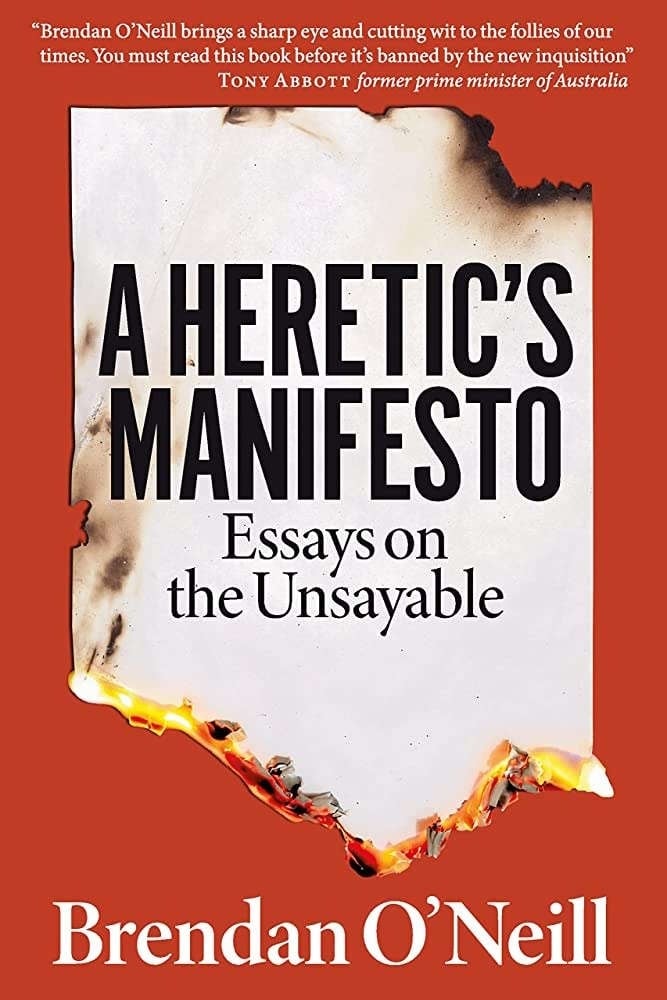
I also read another book called The Heretics` Manifesto by Brendan O`Neill. Little did I know when I read it, and later reviewed it, that it would cause some controversy in my life to the point that I would lose a friend. This was my review.
In his book, Brendan O`Neill states, “It is the thesis of this short book that the constant churn of political correctness–or cancel culture or wokeness or intolerance or whatever we’re calling it, represents not just an over-the-top clampdown on speech, but a crisis of Enlightenment.”
What’s a heretic you may ask? Let me tell you. A heretic is a person holding an opinion that is at odds with general acceptance. Years ago, we may have called witches the heretics of the age, but now we have a new breed. The new breed of heretics is anyone that dare go against the insanity of the modern world. J.K. Rowling stood up and fought for women’s rights. She was called an innumerable number of names and insults. Ms Rowling even had her home address posted online with death threats. There are many more, too numerous to mention.
Mr O`Neill offers the reader an analysis of the current worldwide mania of looking for ‘hate speech’ at every turn, as well as the victim-hood mentality that has begun to dominate in some areas. Those core issues are applied to several discussions through the book. From the first chapter entitled “Her p3n1s” through “C19 as Metaphor” finishing with “Words Wound”, Brendan O`Neill writes with a clarity, a literary freedom and an honesty that is refreshing to see.
The author examines how decades of progress on gay rights have been wound back by the transgender movement and discusses the concept of whether homosexuality is “transphobic bigotry.” His arguments are solid, and fact driven, presented well, and backed up with his documented research. Brendan O’Neill also looks at the toxicity of our past, how the legacies and universal inheritances of our cultures are being dismissed and traduced. He dissects the suggestion that racial thinking has been resurrected. He examines the subject of media and censorship, how it’s an ominous attempt at thought control.
This book is a great read. It’s well presented with current issues. The research and reading done for each chapter, laid out for the reader to examine and follow up if they wish. This is the first book I have read of Mr O`Neill’s and it will not be the last. The language used is perfect for the style of writing. It is almost a conversation in some points particularly as our author discusses the attraction of cancel culture in today’s world.
Throughout history, there have always been people pushing society forward, giving innovative ideas and thoughts. However, nowadays, these people are in short supply. Mr O`Neill reminds us through his words that we need to arm ourselves intellectually and morally for the battles ahead. This book does much more than look at issues in society, it also provides solutions and encourages a call to arms for everyone. All too often, we stand with the majority, to be part of the ‘in crowd’ and for fear of pressure from those around us. But now it is time to stand up for what is right and what you believe in, even if you are standing alone.
As he says, “the more we refuse to be censored and exercise our right to be offensive, to exercise free speech and independent thought, the better it will be for us all. This is a critical time in the world now.”
Now, before you come running at me, what you have to remember is that enjoying a book and agreeing with everything inside it are two remarkably different things. We can admire an argument without adopting it and we can appreciate a writer’s ability to provoke thought without signing a lifelong membership to their worldview.
Somewhere along the way, we seem to have forgotten that. Reading has become a tribal war. Books are no longer judged on the character or the story. They are no longer judged on how well they’re written or how well they argue a case. The content of books is judged on whether they are saying the right thing. What do I mean by the “right” thing? I’m talking about subjects believed the right thing by media, the approved narratives on identity, history, climate, gender, race, or power that the cultural gatekeepers have decided must be affirmed at the time.
A novel can be a lousy plot. Poorly written. Have wooden and unintelligent characters but if it ticks the “correct narrative” boxes, it is praised. On the other end of the scale, a crafted book with the perfect plot and characters, or one that argues on an intelligent point, and does it well, will be dismissed because it doesn’t meet the “narrative.”
The Heretics’ Manifesto argues that society has become increasingly hostile to disagreement. That expressing an unpopular opinion can carry consequences far beyond a heated conversation. Ironically, my experience after reading it became a perfect demonstration of the book’s central argument.
I mentioned online that I had enjoyed it. Not that I’d converted to a new ideology. Not that Brendan O’Neill was right about everything. I simply commented on how that I thought it was an intelligent, well-argued read, that backed up what was said with research that was presented for the reader to use as added reading if they needed.
That was enough. One person whom I had considered a friend decided to debate my review publicly on social media and questioned why I seem to have believed Mr O’Neills work. That same person disappeared all together from my life, over one book review. Apparently, curiosity and opening my eyes by reading a book by a new author had become a character flaw. That fascinates me more than it angers me.
What happened to asking someone why they liked a book? What happened to conversations that began with genuine curiosity instead of instant judgement? Surely the whole point of reading widely is exposing ourselves to ideas that don’t fit inside our existing beliefs. If every book simply confirms what we already think about life and events, what is the point?
The best books unsettle us. They make us pause halfway through a chapter because they have articulated something we had never considered. Sometimes they persuade us. Sometimes they reinforce why we disagree. Sometimes they make us stop, shut the book and wonder, ‘but why?’ We should have questions about what we read.
Reading only within our comfort zone is not intellectual growth. It is confirmation bias with a bookmark. What’s made this worse is social media. Platforms reward certainty over curiosity. They reward outrage over curiosity. Nuance disappears because outrage travels faster. You’re expected to declare your team before you have even opened the first page. Once you’ve done that, every opinion you express becomes evidence either for or against your own morality.
To be honest, it is just exhausting. It gets to the point where recommending a book can be interpreted as endorsing every belief its author has ever expressed. That is absurd. I’ve read dictators, revolutionaries, atheists, theologians, libertarians, socialists, conservatives, and progressives. I’ve read about film stars, soldiers, royalty, and musicians. I’ve read love stories, biographies, historical fiction, historical nonfiction and more. Reading all of them didn’t convert me into any of those things simultaneously. It simply made me better informed about how different people think.
Isn’t that what reading is supposed to do? Books should expand our understanding, not shrink it.
I suspect many people who criticised The Heretics’ Manifesto never actually read it. They were reacting to Brendan O’Neill’s reputation rather than engaging with his arguments. That’s becoming increasingly common. We outsource our opinions instead of forming them ourselves.
Someone tells us a book is problematic. Someone else says an author should be ignored. So, we never read the book. We inherit conclusions without doing the work. That is a dangerous habit, regardless of which side of politics you’re on.
You do not have to agree with Brendan O’Neill. I certainly don’t agree on everything. But dismissing ideas before you have examined them doesn’t prove intellectual confidence. It shows intellectual fear.
The friendship I lost over this book review saddened me. Not because someone disagreed with my opinion. Disagreement is healthy. It is because it ended the conversation instead of starting one. Real friendship should be able to survive a difference of opinions about politics, books, and culture. If it can’t, maybe that friendship was not as strong as I believed.
These days, people talk endlessly about diversity. Isn’t diversity of thought just as valuable? After all, if every bookshelf holds exactly the same approved authors saying exactly the same approved things, we are not cultivating readers. We are cultivating a bunch of echoes.
And that seems a far greater threat to free thinking than any controversial book sitting quietly on a shelf.